Weaving Around the Giants - How the middle powers are building a world that runs without Washington or Beijing
13 Jul 2026
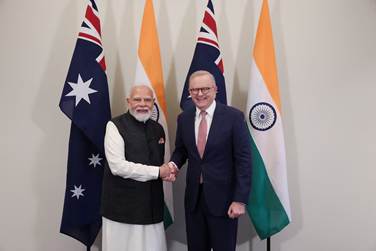
There is a particular kind of diplomacy that photographs well. A prime minister received on a tarmac by the Riviera light of Nice in France. The two leaders touring a startup exhibition, grinning like men who have found money on the pavement. A Japanese premier calling her Indian counterpart her elder brother, and being called a sister in return, with all the weight that word carries in a country where a thread tied on a wrist is a lifelong vow. A uranium deal signed in Melbourne after twelve years of paperwork, sealed with a handshake and a stadium of thirty thousand.
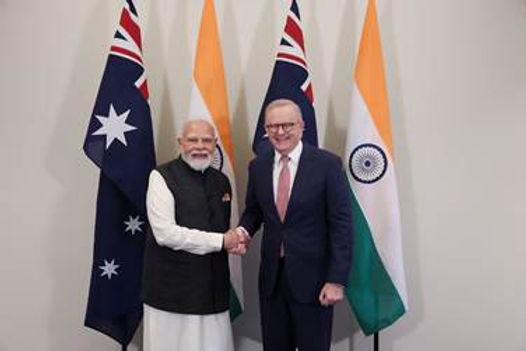
Watch the footage with the sound off and something odd surfaces: the body language repeats. The way Macron leans in toward Modi, hand on forearm, is the same easy proximity Modi shares with Takaichi of Japan, with Prabowo of Indonesia, with Albanese of Australia, and with Luxon of New Zealand – the loose, delighted, slightly conspiratorial warmth of a team that has just been formed after long trouble apart, and cannot quite believe how well the parts fit. It is the vibe of a dressing room before the season starts, not a summit communiqué. That is either sentiment worth nothing, or the first visible sign of something real. This piece is about telling the two apart.
Individually, each of these is a bilateral event, the ordinary furniture of foreign policy. Taken together over a single stretch of 2026, they start to look like something else: not a line of countries queuing to pick a side, but a set of threads being tied – quietly, deliberately – into a mesh. The interesting question is what is being woven, and who is being left out of the weave.
The shape of the argument
The thesis worth taking seriously is this. For two decades the organising fact of world affairs has been the rivalry of two giants – the United States and China – and everyone else has been asked, more or less politely, to pick a side. What has changed recently is not that a third giant has emerged. It is that the middle powers have stopped waiting to be asked. They are wiring themselves together directly, in trade, energy, technology and defence, building a lattice of relationships that does not route through Washington or Beijing at all.
Call it, for want of a better word, the lattice. A lattice is not a pyramid: it has no apex, no hegemon sitting at the top handing down permissions. Nor is it a bloc drawn up in ranks against an enemy. It is a mesh – many small members, tied to each other at many points, load-bearing precisely because it has no single load-bearing point. The aim is not to encircle the two giants, or isolate them, or form a phalanx against them; that would be a smaller and more brittle ambition. The aim is to build independently of them: to weave, in partnership with other rules-based states, the freight and fuel and code of an order that simply does not have to ask their permission to function. Not a world organised against two, but a world quietly learning to hold its own shape without needing them at the centre of it.
The evidence for it in a single year is genuinely striking. India and France elevated their partnership to a "Special Global Strategic Partnership" and co-chaired two consecutive global AI summits – one in Paris, the next hosted by India itself – while France seated India at the G7 table as a standing outreach partner. Japan’s new prime minister, Sanae Takaichi, arrived in Delhi and spoke openly of two nations leveraging complementary strengths "in the midst of international affairs in disarray" – a phrase that does a lot of quiet work. And in Melbourne, Australia finally converted a decade-old civil-nuclear agreement into a live uranium supply line to India, bundled with critical minerals, maritime security and a space-tracking terminal in the Indian Ocean.
None of these arrangements needed a superpower’s permission. That is the part that is new.
Where the thesis is strong
The strongest version of the argument is about supply chains and energy because that is where dependence is most concrete and diversification hardest to fake.
The uranium deal is the cleanest illustration. India is chasing a nuclear target – 100 gigawatts by 2047, up from eight today – that is one of the most ambitious energy build-outs any nation has attempted. To fuel it, India has spent 2026 signing with Kazakhstan, Canada and now Australia in quick succession. The logic is explicitly about not depending on any single supplier, in a global uranium market where, as the trade analysts drily note, scarcity is political rather than geological. When a country deliberately spreads its most critical dependency across several rules-based partners, it is buying insurance against exactly the kind of coercion the two giants have both, at various points, been willing to use.
And the fuel is only half the story; the reactors are the other. Here the pattern bends in an instructive way. The most sought-after nuclear construction technology on the market is Russian: Rosatom builds more reactors abroad than anyone else on earth – by some counts more than all Western vendors combined – and its flagship VVER design anchors plants from Turkey to Bangladesh to Hungary. India, a customer and partner of four decades, is the beneficiary. Kudankulam, the country’s most powerful nuclear station, is a Russian build, and Delhi is quietly finalising a second site for another. It is the kind of technology a supplier parts with only for an ally it trusts across generations, and Moscow has parted with it for India. The lattice, in other words, is not made only of Western rules-based partners; it is catholic about where the best plumbing comes from, so long as the dependence is diversified and the relationship is old enough to weather a storm.
The same instinct runs through the critical-minerals pacts, the semiconductor and quantum MoUs with France, the green-hydrogen cooperation with Australia. These are the unglamorous plumbing of sovereignty – and they are the actual threads of the lattice. Not the communiqués and the warm words, but the offtake contracts and the shipping lanes. They are being laid by and between middle powers, for middle powers, and each one is a knot that makes the whole mesh a little harder to pull apart.
Where it overreaches
Now the honest caveats because a good argument survives them and a weak one does not.
First, the uranium deal is not a substitute for American energy, and it is worth not overstating it. It substitutes away from a narrow supplier base toward a broader one, and away from fossil fuels toward nuclear. That is real, but it is diversification and decarbonisation, not a divorce from Washington. The commercial export volumes, the trade press is careful to say, remain near zero and will grow only slowly. The handshake is genuine; the shipments are hypothetical.
Second, building independently of the giants is different from building without them, and it is worth being clear-eyed about the difference. India spent 2026 negotiating a trade arrangement with the United States that lifted a round of tariffs; the same G7 that seated Modi also seated the American president. Australia’s pivot toward India is partly a hedge against its dependence on China – one giant quietly used to balance another. And the Russian reactors are their own reminder: independence from Washington is here bought partly with dependence on Moscow. The middle powers are not conjuring a world in which the two do not exist. They are building enough independent structure that they are no longer captive to either. That is a more modest claim than the romantic one, and a far more durable one.
Third, warmth is cheap and brotherhood is a genre. The Rakhi framing between Modi and Takaichi is moving, and the Indian diaspora receptions are real political theatre with real feeling behind them. But amity has historically been the packaging of interest, not its engine. That easy body language in the photographs is the most seductive evidence and the least reliable; it is exactly what a formed team looks like, and exactly what a set of leaders performing one looks like too. The test of this alignment is not how the leaders describe it but whether the offtake contracts get signed, the minerals actually move, and the cooperation survives the first hard disagreement. Teams look like teams in the friendly matches. You learn who they are in the tie they lose.
Two lighthouses from the past
History does not repeat, but it keeps a lighthouse or two burning for anyone sailing this particular coast. Two are worth steering by.
The first is a warning. Renaissance Italy – Florence, Venice, Milan, the Papacy, Naples – spent the late fifteenth century in a self-conscious balance of power, each state too weak to dominate, all quietly combining against whichever of them grew too strong. For decades it held a fragile, ingenious peace. Then, in 1494, a genuinely large outside power marched in: France crossed the Alps, and the whole delicate machine collapsed almost overnight. The Italians had mastered balancing each other and never learned to face a giant. The lesson for the middle powers is exact. A lattice tuned only to manage relations among near equals is not the same thing as a structure that can withstand a giant who decides to lean on it. Build for the second, or the first will not survive contact.
The second is an encouragement, and it is the better model. The Dutch Revolt produced something the sixteenth century thought impossible: a scatter of small, waterlogged provinces that outlasted the Spanish empire, then the hegemon of the age, not by matching its armies but by turning commerce, credit and stubborn networked cooperation into strategic weight. They were mercantile, rules-bound among themselves, and patient. They won by building – ships, banks, trade routes, institutions – rather than by confronting. If the lattice has a patron saint, it is the United Provinces of the Netherlands, because they prove the essential point: you do not have to be large to be indispensable. You have to be woven into things other people cannot do without.
India has stood in this current before and knows how it can disappoint. The sharpest modern attempt was the one nobody quite pulled off: the Non-Aligned Movement of the Cold War, when Nehru, Nasser, Tito, and Sukarno refused to be sorted into either camp and tried to build a bloc defined by not choosing. It never became a true pole of power. But it changed the vocabulary of world politics permanently, and it is the direct ancestor of what Delhi is attempting now – strategic autonomy, dressed this time in twenty-first-century supply chains rather than twentieth-century summitry. The difference is the ballast. Non-alignment was a posture; a lattice of uranium, minerals and sea lanes is a structure.
The lights say one thing between them. Build around something concrete – fuel, minerals, sea lanes, the plumbing others depend on – and the structure holds, as the Dutch held. Build only a clever arrangement among friends, and it stands exactly until the first giant tests it, as Italy’s did not.
What to watch
None of this yet amounts to a new world order, whatever the communiqués imply; that is the press-release version, and 2026 is too early for it. What it amounts to is quieter and more interesting: a season in which the middle powers stopped behaving as swing votes and started behaving as principals, laying down the physical infrastructure – fuel, minerals, chips, sea lanes – of a world they could run without asking. Not a bloc against the two giants. A structure independent of them, built with whoever else will play by rules.
The Dutch would recognise the move
Whether the alliance holds or unravels into a set of well-photographed handshakes depends on the least romantic things imaginable. Not the warmth of the welcome in Nice or the thread tied at Hyderabad House, but whether the uranium ships and whether the minerals flow.
Brotherhood makes the photograph. Freight makes the alliance.
This article was first published in The Slate under the column 'The Deep Slice'